Built one at a time in FloridaFree lower-48 shipping

Field notes · failures · fixes · standards

Engineering Notebook

The shop record behind the product. These are documented design decisions, failure modes, planned tests, material studies, and structural lessons gathered while building Freedom Crates.

8current entries
3adopted design rules
1planned validations

Why publish the notebook?

Because “built tough” should have receipts.

This is not a claim that every idea is finished science. Entries are labeled honestly as adopted, ongoing, planned, or analysis. When a failure teaches us something, the design rule changes. When a test is still planned, it stays marked planned until real data exists.

Search the shop record

Test log

Showing 8 of 8 notebook entries
Freedom Crate 9mm ammo crate showing raised structural legsAdopted
FC-LEG-2025-001Feb 2025 · ongoing field observation

1¼-inch SPAX Power Trim screws on 1×2 legs

Standard legged Freedom Crate designs

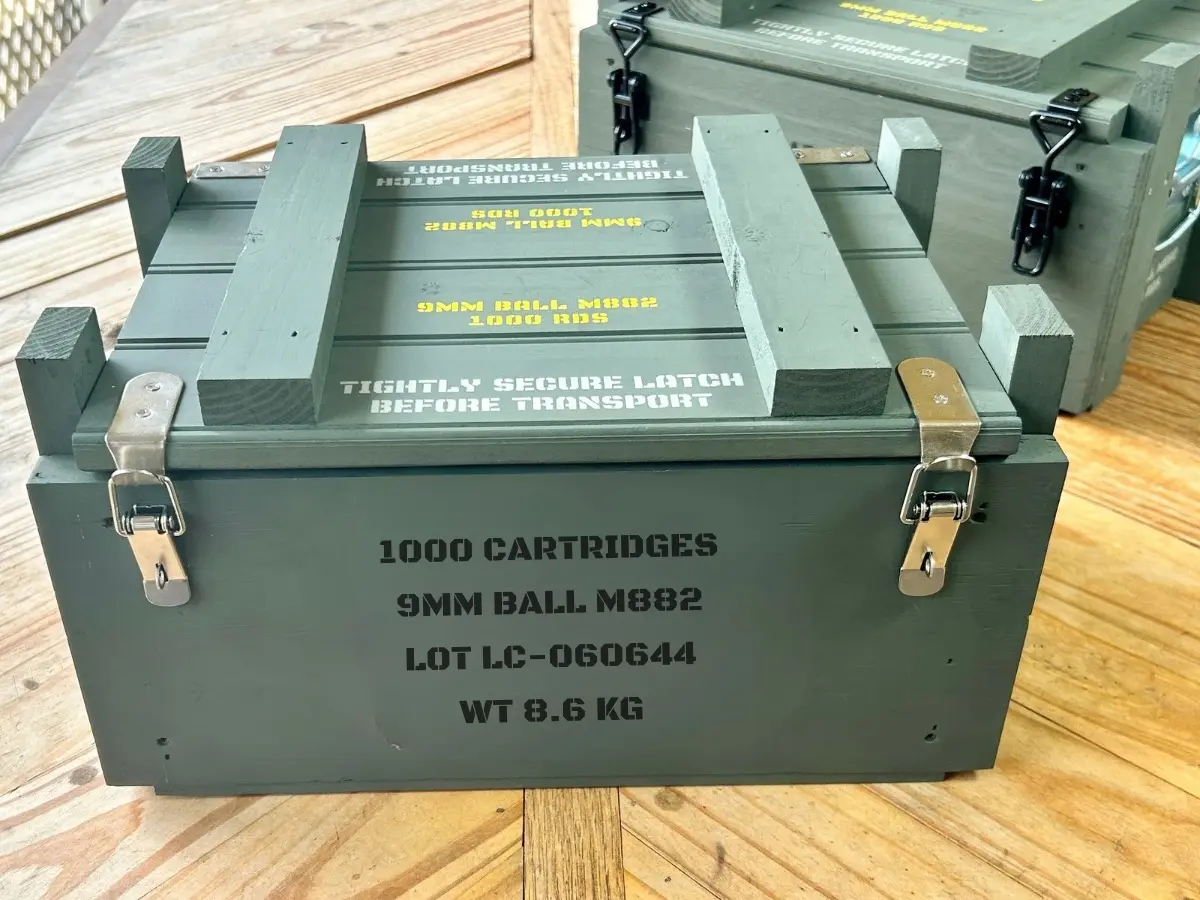
Shipping damage showed that the raised legs absorb a disproportionate amount of impact. The attachment evolved from glue and brads alone to glue, brads, and two diagonally placed SPAX structural screws per leg.

structurehardwaredrop
Open engineering notes

Method

  • Install each leg with adhesive and brads as before.
  • Add two 1¼-inch SPAX Power Trim screws per leg in a diagonal high/low pattern.
  • Monitor shipped boxes for separation, cracking, loosening, and impact damage.

Observed behavior

  • The legs behave like sacrificial impact structures during drops and rough shipping.
  • The screw-plus-glue-plus-brad stack is substantially more rigid in tension and shear than glue and brads alone.
  • The current tall-leg stacking design protects lid finishes, but the smaller contact footprint can reduce stacking stability.

Next design question

A future interlocking groove or locating feature on the legs could preserve lid protection while improving stack stability.

Current conclusion

Two 1¼-inch SPAX Power Trim screws per 1×2 leg are now treated as a standard structural requirement on applicable Freedom Crate designs.
Freedom Crate RangeMaster 400 being carried by its handle systemAdopted
FC-HANDLES-2025-0012024–2025 · design evolution

Enclosed nylon-webbing handle system

Crates using 1-inch nylon webbing and raised legs

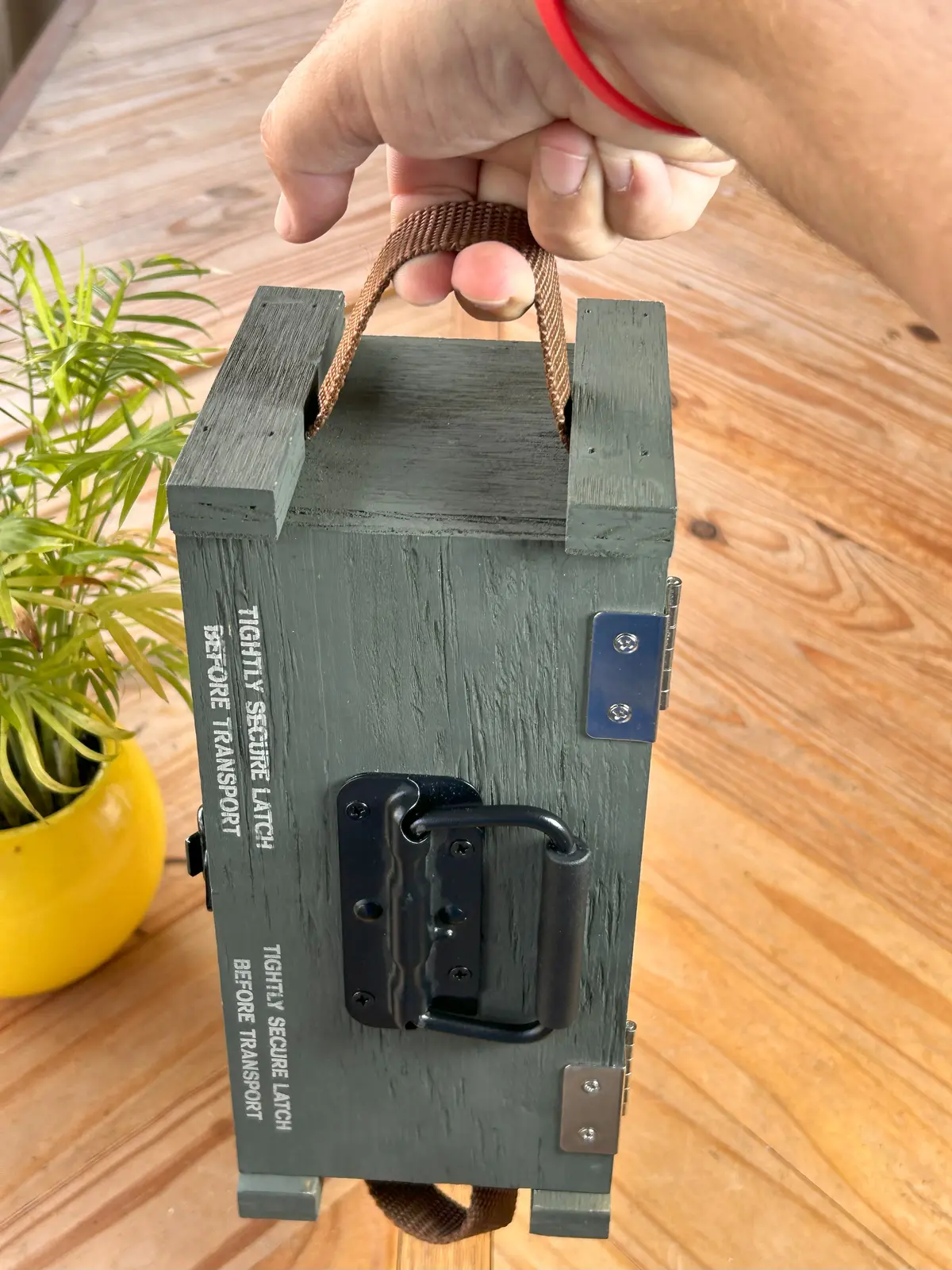
The handle system moved away from through-hole rope handles and interior knots to an exterior webbing anchor concealed beneath the leg. The change recovers interior volume, reduces air paths through the side panel, and creates a serviceable multi-point failure system.

structurehardware
Open engineering notes

Why the rope design changed

  • Interior knots consumed usable storage space.
  • Through-holes created unnecessary air paths through the storage cavity.
  • A surface-mounted system keeps the interior clean and unobstructed.

Fail-safe behavior

  • The leg physically encloses the handle screw head and webbing tail.
  • A true handle failure would require the leg, screw anchorage, or nylon webbing to fail rather than a single exposed fastener simply backing out.
  • The leg can be removed for field replacement of worn 1-inch webbing and then re-fastened.
Current conclusion

The enclosed leg-integrated nylon handle is the preferred current design because it combines strength, cleaner interior packaging, serviceability, and fewer critical failure modes.

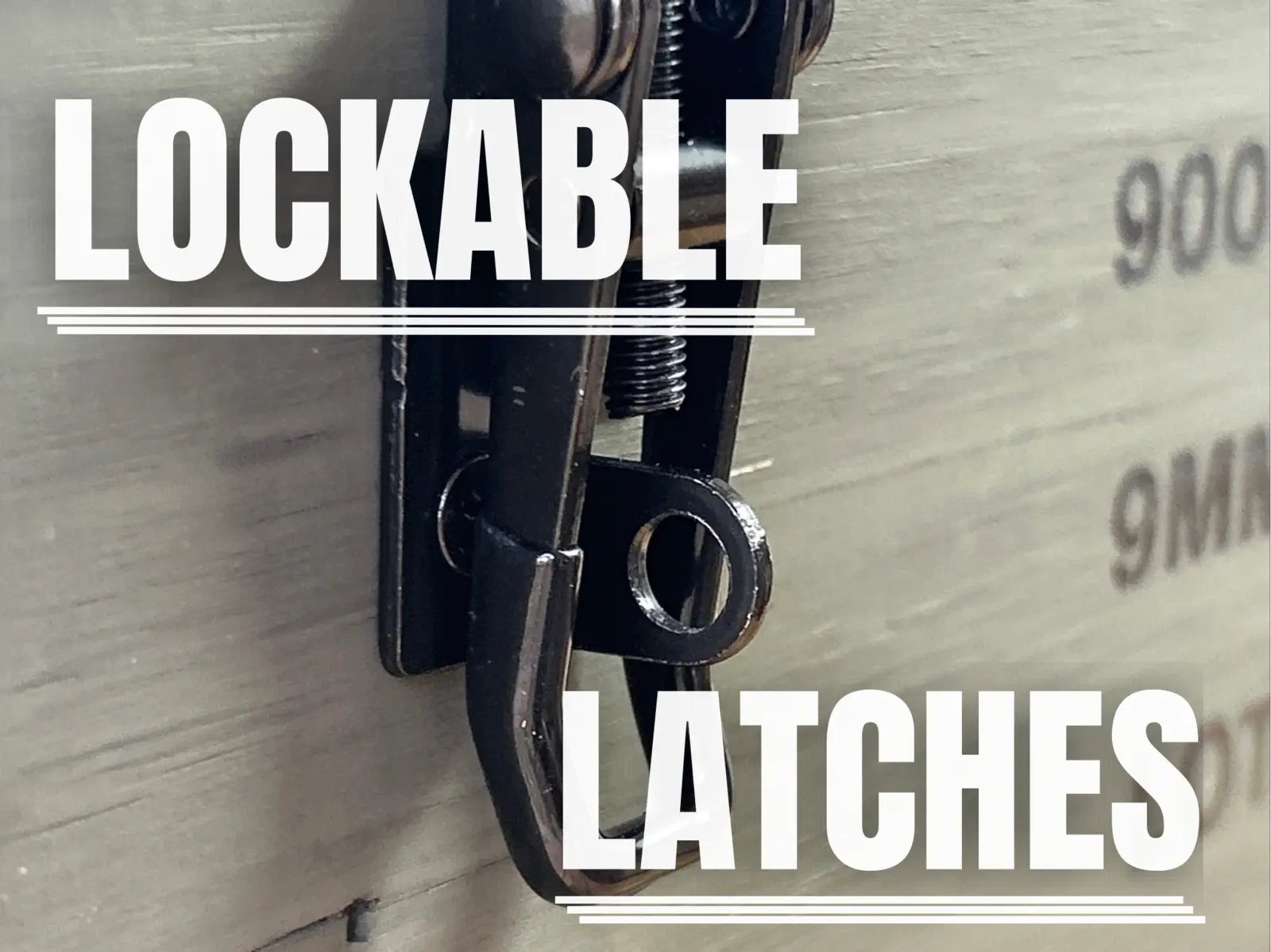
Close view of lockable hardware on a Freedom Crate RangeMaster 400Adopted
FC-LATCH-2025-0012024–2025 · repeated-cycle testing

Edge-mounted catches vs. 90-degree latch catches

Lockable toggle-latch crate designs

Early black hardware builds used edge-mounted latch catches because matching black 90-degree catches were difficult to source. Repeated tightening concentrated load into the lid edge and exposed a pull-out failure mode.

hardwarestructuredrop
Open engineering notes

Observed failure

  • Repeated latch cycles and customer-style over-tightening loosened edge-mounted catches.
  • Even longer screws could not fully eliminate the weakness created by loading the lid edge grain.
  • The failure mode was severe enough to remove edge-mounted catches from field-use configurations.

Production response

The design moved to Protex 90-degree black latch catches so the hardware anchors into the face and long-grain wood rather than relying on the fragile lid edge.

Current conclusion

Edge-mounted latch catches are not approved for real field-use crates. 90-degree catches are the required configuration for lockable field and shipping builds.

Loaded Freedom Crate RangeMaster 400 ammunition storage cratePlanned
FC-RM400-2025-DR01Planned validation test

RangeMaster 400 loaded waist-height drop test

RangeMaster 400

The planned test loads a production-style RangeMaster 400 to a realistic customer weight and drops it onto concrete from roughly waist height in multiple orientations to identify the first true structural failure point.

dropstructurehardware
Open engineering notes

Planned method

  • Record starting weight and representative contents.
  • Drop from approximately three feet onto concrete in flat, edge, and corner orientations.
  • Inspect joints, lid alignment, hardware, fastener pull-out, and liner damage after each impact.
  • Capture stills and video so any design change is traceable to the test result.
Current conclusion

This entry remains intentionally marked planned until the physical drop sequence is completed and measured results can replace assumptions.

Armor Core interior inside a Freedom Crate RangeMaster 400Ongoing
FC-EPOXY-2025-INT01Ongoing long-term observation

Penetrating epoxy flood and interior corner fillet

Armor Core™ interior system

Armor Core uses penetrating epoxy to soak exposed wood fibers and form a continuous radius at interior seams. The test tracks moisture resistance, lower-box stiffness, seam stability, and wear over time.

coatingsstructurematerials
Open engineering notes

What is being monitored

  • Cracking or separation at lower interior joints.
  • Water staining, swelling, or delamination.
  • Changes in squareness or lid fit.
  • Wear where loose ammunition and gear contact the protected interior.

Early observation

The cured corner radius appears to spread load across the seam rather than concentrating stress at a sharp 90-degree joint, while also sealing the most vulnerable interior edge path.

Current conclusion

Armor Core remains an active durability system under long-term observation; early shop and field behavior supports continued use of the penetrating epoxy and reinforced interior approach.

RangeMaster 400 schematic showing structural crate layoutAnalysis
FC-JOINERY-2025-0022024–2025 · structural analysis

Joinery strength vs. production time

Freedom Crate utility and range platforms

The objective is not simply to choose the theoretically strongest woodworking joint. It is to find the best repeatable structure once adhesive, epoxy reinforcement, the bottom panel, production time, and real-world racking loads are considered together.

structurematerials
Open engineering notes

Joinery comparison

  • Dovetails are exceptionally strong as bare wood joints but add substantial production time for little practical field benefit here.
  • Finger joints are strong but slower and less forgiving of a machining error.
  • Half-laps provide large long-grain glue surfaces, mechanical overlap, fast repeatability, and excellent strength once the structure is reinforced.
  • Simple butt joints require more secondary reinforcement and are not the preferred rugged-crate solution.

The bottom panel matters

The quarter-inch plywood bottom functions as a shear diaphragm: it squares the box, resists racking and torsion, and distributes load across the complete lower structure.

Top reinforcement ranking

A full interior top diaphragm is the strongest concept considered, followed by substantial wooden gussets, a continuous perimeter collar, plywood corner plates, heavy steel angles, epoxy fillets, and finally small steel corner braces used primarily for alignment.

Current conclusion

Half-lap construction combined with a shear-locking bottom panel offers the strongest current balance of production speed, repeatability, and rugged real-world performance.

Claymore Field Crate built from exterior-grade plywoodOngoing
FC-MATERIAL-2025-0012024–2025 · ongoing material study

Material strategy by crate mission

Branch, field, RangeMaster, and specialty builds

No single sheet good or board is ideal for every Freedom Crate. Material selection is being treated as a mission-specific engineering choice rather than a one-material marketing claim.

materialscoatingsstructure
Open engineering notes

Current working strategy

  • Ceremonial and indoor presentation builds: smooth ¾-inch sanded plywood where finish quality and stencil presentation are the priority.
  • Field-oriented platforms: ¾-inch exterior-grade UTX plywood where moisture resistance and utility matter more than a furniture-smooth face.
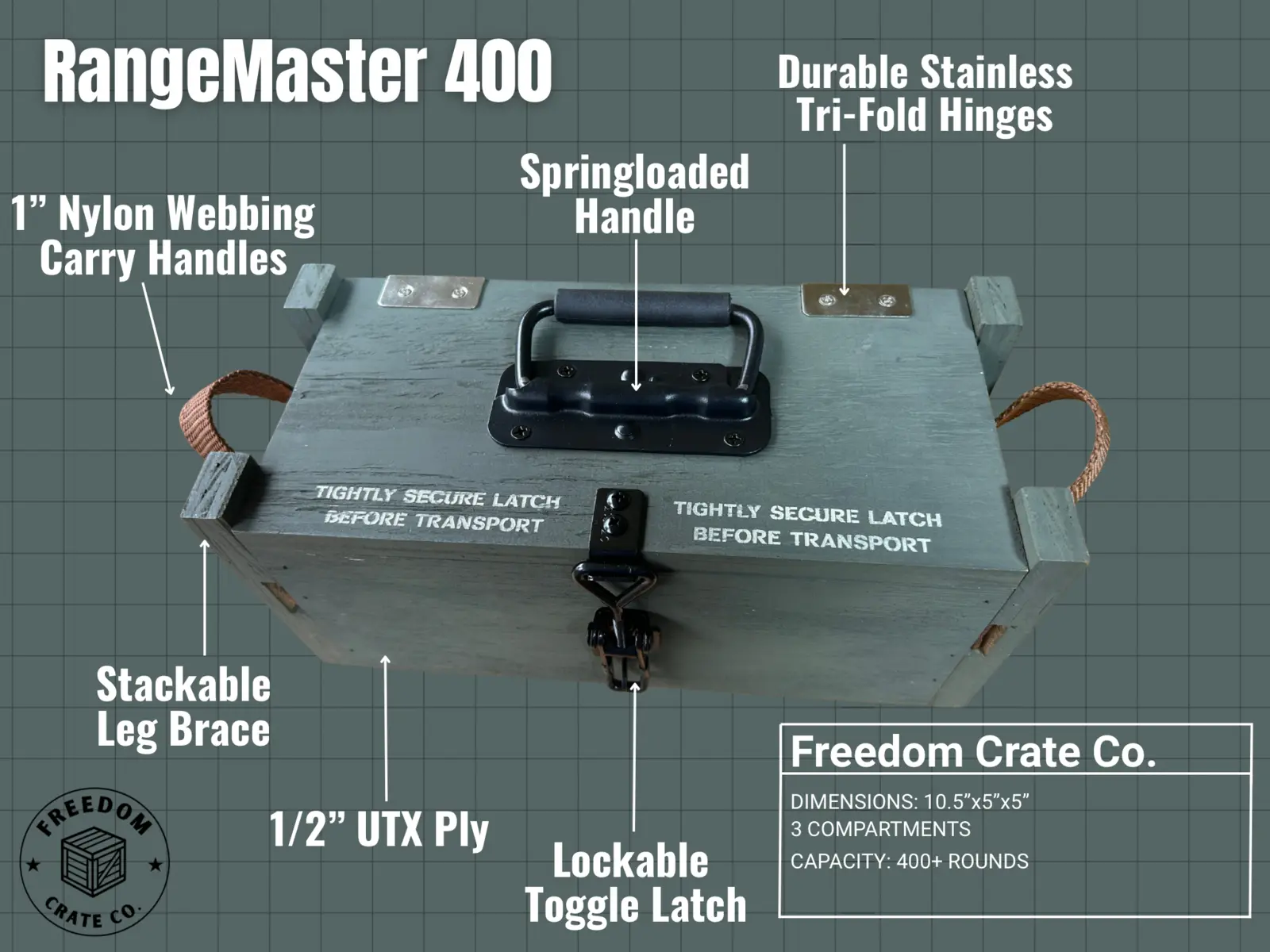
  • RangeMaster 400: ½-inch sanded plywood paired with the Armor Core interior system to keep the platform compact while reinforcing the protected interior.
  • Solid pine: reserved for specialty builds where traditional real-wood character outweighs production consistency.
  • UltraHEX / phenolic film-faced plywood: future heavy-duty candidate pending sourcing and real testing.
Current conclusion

Material choice follows the intended mission of the crate. Appearance, field exposure, weight, machining time, finish system, and structural reinforcement all factor into the selection.

Traditional Freedom Crate removable tongue-and-groove slide-top lidAnalysis
FC-TG-2025-0012024–2025 · shop measurements

Tongue-and-groove lid boards: wide vs. narrow profiles

Traditional and reinforced solid-wood lids

Big-box tongue-and-groove boards vary in width, density, weight, machining behavior, and seam geometry. Those differences matter because the lid sees repeated handling, stacking, impact, latch load, and hardware cycles.

materialsstructure
Open engineering notes

Why solid tongue-and-groove is retained

  • Solid wood avoids plywood edge delamination at the lid perimeter.
  • The tongue-and-groove profile self-aligns the boards and stabilizes the seam.
  • Solid edges accept penetrating epoxy cleanly and maintain strong hardware bite.
  • The construction preserves the traditional military-crate character customers expect.

Trade-off

Plywood would be faster, flatter, and more predictable to machine, but the lid is one of the most abused components. Current production continues to favor solid tongue-and-groove construction where that design is specified.

Current conclusion

Tongue-and-groove remains the preferred solid-wood lid system for the applicable Freedom Crate platforms while dimensional differences between suppliers continue to be tracked in the shop.

Notebook rule 01Failures stay in the record.

The purpose of this page is to show how the products evolve—not to pretend every first attempt was perfect. Design notes may be updated as new field data, shipping feedback, or physical testing changes what we know.